Analysis
28 Years Later: when the future is not enough to measure a sequel’s time
The number in the title announces a chronology, but the film makes it legible in another way: as a culture forced to rebuild its gestures, its stories and its sense of danger. This analysis is limited to documented formal decisions and avoids treating franchise continuity as an automatic explanation.
A number does not explain duration
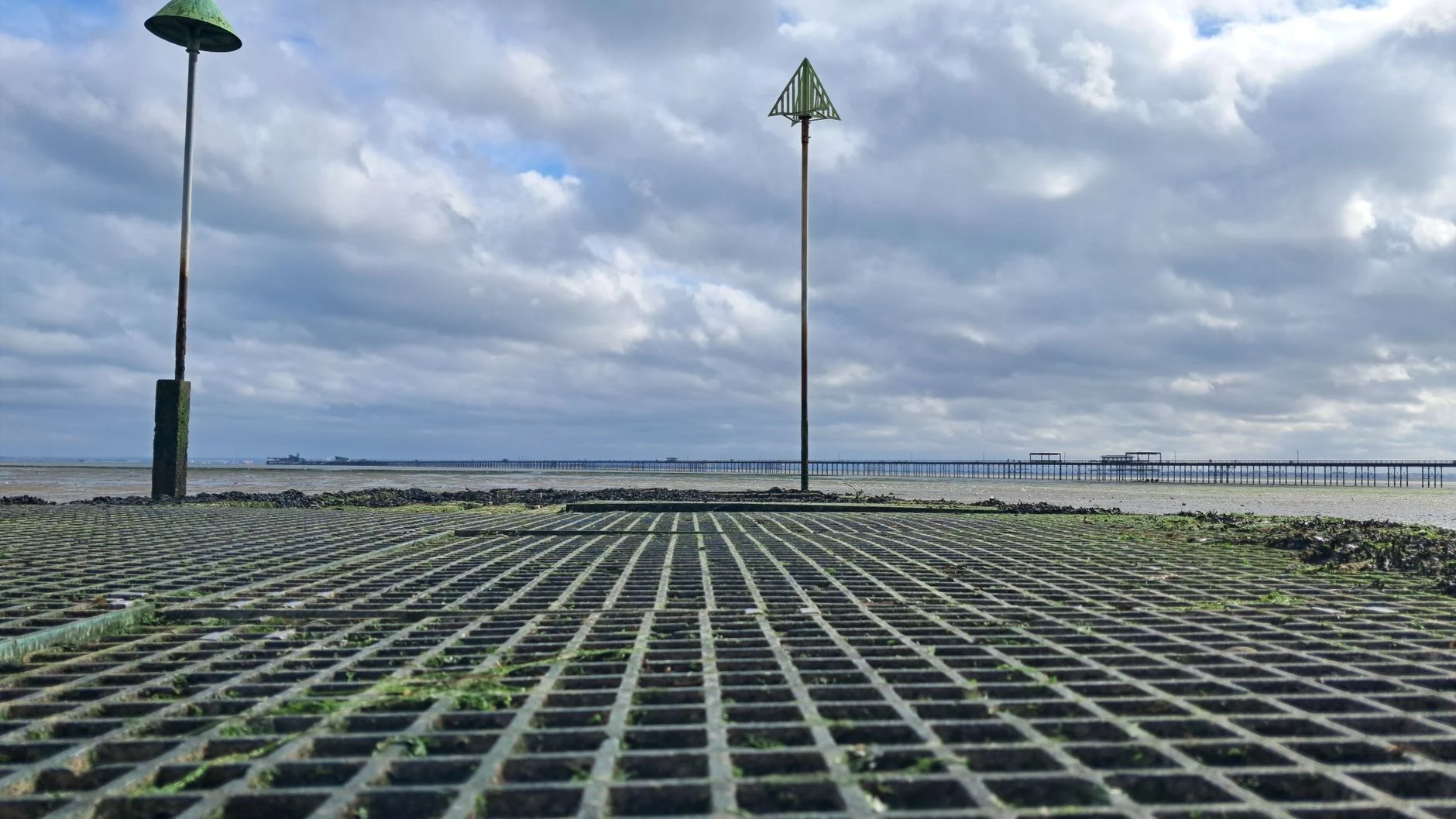
The title seems to promise an exact measure: 28 years since the initial spread of the infection. But cinema does not convey the passage of time through calendars alone. It makes time tangible through rhythms, repetitions, omissions and changes of scale. A shot of an abandoned space can suggest wear; an abrupt transition can make an entire period opaque; an action repeated as ritual can reveal that a community has turned necessity into custom.The island and the causeway are decisive tools in this operation. They are not merely places where events occur: they organise two incompatible speeds. The island enclosure concentrates a regulated life, while the mainland functions as a territory of exposure, distance and threat. Every crossing of the causeway makes time a material condition as well: there is a window in which to cross, and a border whose safety does not depend on an abstract line on a map. When revisiting the film, it is worth paying less attention to whether the landscape “looks post-apocalyptic” than to a more precise question: which tasks, journeys and waits make it visible that this world has been functioning under restrictions for a long time.
The distinction matters because it prevents production design from being reduced to end-of-the-world decoration. A space records duration when it shows habits and limits. The settlement is not evidence that 28 years have passed simply because it looks old; it becomes evidence if the viewer finds accepted rules, adapted tools and a stabilised relationship to the outside world. Long time becomes believable when it stops being information and becomes behaviour.
The present is pierced by images that do not belong to it
The film introduces a more explicit procedure: editing that brings together war material, fragments of Henry V, images connected to the 2007 instalment, and the 1915 recording of Rudyard Kipling’s poem Boots. It would be unwise to call this an ellipsis in the strict sense. An ellipsis removes a stretch of action; this editing instead overlays heterogeneous historical layers and creates an associative rather than chronological continuity.That distinction changes the reading. The sequence does not seem merely to say that “the past explains the present”. Its force lies in the fact that these images reach the present already mediated: they are remnants of a national culture, wartime memory and audiovisual narratives that an isolated community may repeat without necessarily retaining their contexts. The sequel’s time thus becomes a time of faulty transmission. What is inherited does not remain intact; it becomes slogan, gesture, fantasy of resistance or ritual.
That is why it is more useful to describe the operation before interpreting it. First: there is an old recording with an insistent cadence. Second: images from different records and fictions appear. Third: the editing lets those origins collide with the contemporary narrative world. Only then can a reading be proposed: the film makes the 28-year interval perceptible not by reconstructing every lost stage, but by showing an isolated society making meaning from available fragments.
On a second viewing, listen to repetition before settling on the cultural reference. The rhythmic insistence of Boots can work as a measure without a clock: it does not tell us how many days have passed, but installs a march that seems never to end. The effect is especially apt in a film where the past does not remain behind as background, but returns as material that organises the present’s imagination.
The width of the frame makes space an obligation to look
Boyle and cinematographer Anthony Dod Mantle developed the film in a 2.76:1 widescreen format. The decision does not by itself guarantee a form of suspense, but it creates a clear condition: the frame can reserve lateral expanses where the threat has not yet been located. Rather than treating the landscape as a postcard of ruin or reclaimed nature, the wide frame can demand constant exploration.Here time is experienced as perceptual delay. The viewer has to scan a larger surface, anticipating that something may burst in from the margins or already be present without occupying the dramatic centre. The threat need not appear in order to act: it is enough for the frame to show too much breadth for the eye to work before the narrative confirms danger.
This procedure also qualifies the notion that a 28-year jump equals an empty world. Open spaces do not necessarily communicate freedom. They can communicate exposure. If the settlement defines and regulates, the outside expands the gaze until it becomes vulnerable. The contrast between the two spaces does not merely organise the characters’ route: it alters the viewer’s time. Inside, the repetition of communal life may dominate; outside, perception stretches out because every edge of the frame becomes a possible source of incomplete information.
The useful question is not “where is the monster?”, but “how long does the film take to let us know where to look?” That small shift moves the analysis away from creature design and towards the management of the frame.
A light camera does not equal spontaneity, but it changes the relationship with bodies
The principal use of iPhone 15 Pro cameras and compact equipment has driven much of the conversation around the production. Two simplifications should be avoided. The first is to confuse a consumer tool with an automatic aesthetic: the film was not made without planning, accessories, lenses, stabilisation and testing. The second is to treat the technical fact as a curiosity separate from form. The mobility sought by Boyle and Dod Mantle does help explain a particular relationship between camera, terrain and body.The production worked in mud, sand and forests with mobility as an explicit priority. That condition may be felt in the physical proximity to performers and in the way the landscape ceases to be a stable background. A small camera can move closer, travel with a body and occupy positions that are difficult for heavier machinery; but its meaning depends on when editing preserves that closeness and when it interrupts it. The point is not to identify “phone footage”, but to observe what kind of access to the body each shot makes possible.
The team’s most revealing statement concerns a camera array that made it possible to surround an action and choose, in editing, successive perspectives on the same instant. Boyle described the device as a way to move forwards or backwards around reality in order to emphasise violence. Here a concrete way of making time visible does emerge: the event is not extended through a long take, but cut up and redistributed across adjacent angles. The instant ceases to be a transparent unit. It opens out, folds back and compels us to reconsider what has been seen.
There is no need to conclude that all the film’s violence works this way. That would be a generalisation without a verifiable sequence breakdown. But the method offers a solid analytical guide: distinguish scenes that accelerate because they omit information from those that intensify because they multiply viewpoints on the same gesture. In both cases, the film may generate urgency; the former does so through lack, the latter through excess.
Time is not only what has passed: it is what the viewer takes to understand
The 28-year interval also affects the distribution of knowledge. The film places its young character before a world whose rules cannot be fully mastered, and organises movements from relative safety towards territories where that knowledge becomes insufficient. The most cautious way to discuss this aspect is not to anticipate revelations, but to attend to the position from which learning takes place.When a film restricts information, narrative time acquires density. We do not see a fully explained present and then a threat that interrupts it; we move through a present whose rules must be inferred. The experience of the time jump does not come only from discovering that the world has changed, but from recognising that the viewer arrives late to a social order already in place. Other characters know rituals, dangers, prohibitions and stories that remain opaque to us.
This strategy makes an exhaustive inventory of everything that happened between the films unnecessary. Indeed, too much explanation could weaken the sense of duration. If everything were clarified as chronology, time would be reduced to administered information. The film appears to seek something more unstable: that viewers feel the effects of a long separation before they can arrange them into a coherent story.
For that reason, the question for a revisit is not only which facts are withheld, but which actions make that withholding carry weight. Notice the moments when a character knows how to orient themselves, what behaviour is acceptable or where a risk lies, against those in which the viewer’s perspective must wait. The sequel’s time is then measured as cognitive distance: the distance between living in that world and arriving from outside to understand it.
The comparison with 28 Days Later must be technical, not reverential
Comparison with the 2002 film is relevant only on one verifiable point: both are connected to a search for light cameras and a desire for technique to form part of visualisation rather than be an added finish at the end. The first film used low-resolution Canon digital cameras in many of its scenes; the new instalment adopts phones and modified systems for a different technological context. The continuity, then, is not an identity of texture or an obligation to repeat shots: it is an affinity of method, the decision to work with lightweight tools in order to obtain specific positions and speeds.There is also a crucial difference. In 28 Years Later, the documented technical range is broader than the slogan “shot on iPhone” suggests: there is a widescreen format, adapted lenses, gimbals, telephoto lenses and camera arrays. This means the device should not be fetishised. The film does not demonstrate that a phone alone replaces a cinematic system; it demonstrates that a production can integrate a small device into a complex architecture of visual decisions.
That precision protects the analysis from franchise nostalgia. There is no need to claim that the new film reproduces the earlier one’s effect in order to identify a conversation between them. It is enough to point to a specific formal issue: how a technological choice conditions proximity, movement and the management of space. Everything else — plot symmetries, character equivalences or supposedly immutable rules of the universe — would require evidence this reading does not need.
Watching again: six questions without turning the number into a total explanation
On a second viewing, try suspending for a moment the fascination with the number in the title. Ask which things in this world are repeated because they are custom, and which because they are necessity. Identify the cuts that spare explanations and the montages that instead accumulate materials from the past. Compare the safety of a bounded space with the optical demand of a landscape that is too wide. Distinguish camera movement that follows a body from editing that breaks down an action from several angles. And, above all, observe when you know something before the characters do and when the film forces you to learn late.These questions make it possible to understand that 28 Years Later does not need to turn every absent year into a piece of information. Time can appear as deterioration, but also as transmission, ritual, framing, blind spot and delay. The sequel matters not because it has advanced by a spectacular number, but, insofar as its formal decisions sustain it, because it makes the distance between films weigh on the act of looking.
Sources and filmography consulted
- www.gq.com. www.gq.com. Consulted 16 Sep 2026
- www.bbfc.co.uk. www.bbfc.co.uk. Consulted 16 Sep 2026
- www.latimes.com. www.latimes.com. Consulted 16 Sep 2026
- britishcinematographer.co.uk. britishcinematographer.co.uk. Consulted 16 Sep 2026
- definitionmagazine.com. definitionmagazine.com. Consulted 16 Sep 2026
- thefilmstage.com. thefilmstage.com. Consulted 16 Sep 2026
- beforesandafters.com. beforesandafters.com. Consulted 16 Sep 2026
- filmmakermagazine.com. filmmakermagazine.com. Consulted 16 Sep 2026
- www.tvbeurope.com. www.tvbeurope.com. Consulted 16 Sep 2026
- www.sonypictures.com. www.sonypictures.com. Consulted 16 Sep 2026
- www.wired.com. www.wired.com. Consulted 16 Sep 2026
- www.wired.com. www.wired.com. Consulted 16 Sep 2026
- teamdeakins.libsyn.com. teamdeakins.libsyn.com. Consulted 16 Sep 2026
- www.motionpictures.org. www.motionpictures.org. Consulted 16 Sep 2026
- www.anothermag.com. www.anothermag.com. Consulted 16 Sep 2026